Hello friends and fellow film lovers!
The Board of Directors has narrowed the list from more than 60 nominated films to 21. We want to make it clear that although the original list was really good, 60 is far too many to get meaningful results in a vote for 12, so narrow we did.
Below are the synopses and links to the previews of each film to help you decide.
Voting will end at midnight November 1st:
★ You must be a subscriber for your vote to count in the final tally. We encourage you to subscribe at the same time you vote, but it is not necessary. You do have to be a subscriber by the time the window for voting closes for your vote to be included in the final tally.
★ You can vote on the website here
(or) By emailing us your list here
(or) By placing a ballot in the suggestion box (all ballots must have your name on them!)
★ You can vote for up to 12 films. Many of our supporters are really happy coming to see what others have selected and opt to not vote at all. We love that trust in our community. Still, if you have just a few that you really want to see make it, you can vote only for them. (Please note you cannot vote for any one film — say “Kung Fu Hustle” — more than once — let alone 12 times! Yes, this is very specific, and we are not naming names — they know who they are.)
Without further ado, here are the candidates for next year’s AFS screenings!
AFS’ List of Potential Films for 2027
- Big Night [1996 / Campbell Scott & Stanley Tucci / 107 min]
- Central Station [1998 / Walter Salles / 113 min]
- Children Of Men [2006 / Alfonso Cuaron / 110 min]
- The Conversation [1974 / Francis Ford Coppola / 113 min]
- Eephus [2025 / Carson Lund / 98 min]
- Girl, Interrupted [1999 / James Mangold / 127 min]
- Heavenly Creatures [1994 / Peter Jackson / 99 min]
- The Hudsucker Proxy [1994 / The Coen Brothers / 111 min]
- In The Heat Of The Night [1967 / Norman Jewison / 109 min]
- Klute [1971 / Alan J Pakula / 114 min]
- Kung Fu Hustle [2004 / Steven Chow / 98 min]
- Lenny [1974 / Bob Fosse / 111 minutes]
- Mahogany [1975 / Berry Gordy / 109 min]
- My Winnipeg [2007 / Guy Maddin / 80 min]
- Nosferatu [1922 / FW Murnau / 94 min]
- Notorious [1946 / Alfred Hitchcock / 102 min]
- Point Blank [1967 / John Boorman / 92 min]
- Quiz Show [1994 / Robert Redford / 133 min]
- Rosencrantz & Guildenstern Are Dead [1990 / Tom Stoppard / 117 min]
- Samsara [2011 / Ron Fricke / 102 min]
- The Treasure Of The Sierra Madre [1948 / John Huston / 126 min]
Big Night [1996 / Campbell Scott & Stanley Tucci / 107 min]
In 1950’s New Jersey two immigrant brothers from Italy have opened a restaurant. Things are not going well, so they plan a make-or-break BIG NIGHT. There are plenty of comedic fouls-ups, but the main problem is the brothers themselves. Primo (Tony Shaloub) is very La-di-da, while Secondo (Stanley Tucci) is very stiff and persnickety.
This film is important because:
While it had no Academy Award Nominations, it did have numerous Critics Choice and Film Festival nominations and awards.
It has a great cast and it’s a lot of fun.
https://youtu.be/lQQhoYLsoHI?si=qi5Xm7Pu3QmJfGDD
Central Station [1998 / Walter Salles / 113 min]
Dora is an older retired woman who earns some cash at Rio De Janeiro’s Central Station by writing and reading letters for Brazil’s illiterate citizens. People travelling thru the station dictate what they want written. She does not always mail the letters for them but stuffs them into a drawer at her home.
One day a woman comes with her young son and has Dora write a letter to the boy’s father. She has not seen him for many years and wonders what happened. When the woman leaves later she is hit and killed by a bus just outside the station. The boy, Josue, is left alone and wanders thru the station. Dora decides reluctantly to take care of him.
Although Dora is a tough cookie, she finds herself drawn to the young boy and decides to help find his father. Dora and Josue set off on a road trip thru Brazil. It’s a journey that for Dora is both physical and spiritual.
This movie won the Oscar for Best Foreign Language Film in 1999. Fernanda Montenegra’s performance as Dora is unforgettable.
https://www.youtube.com/watch?v=qCoqppCsEa8
Children Of Men [2006 / Alfonso Cuaron / 110 min]
Made in 2006 it presents a dystopian future set in 2027. Excellent cinematography. It would be fun to watch this in 2027 to see what they got right.
https://www.youtube.com/watch?v=2VT2apoX90o
The Conversation [1974 / Francis Ford Coppola / 113 min]
Gene Hackman’s Harry Caul is one of the most iconic & recognizable characters in cinema: the little flat-black moustache, the browline glasses, the piece-of-shit raincoat, a pair of overear headphones strapped to his head. He lives a rigidly ordered life: Recording & processing audio during the day, playing saxophone to no one in his miniscule apartment at night, punctuated by the occasional visit to a girl he can’t bring himself to say he cares for. & of course, that control he believes he exerts over his life will be exposed as an illusion, because Harry Caul is the protagonist of “The Conversation”, which had the misfortune of being “the other Coppola film” that came out in 1974.
An inspired slice of dyspeptic paranoia, “The Conversation” has grown in stature with each year as its influence becomes obviously increasingly vast. If you aren’t familiar with its plot, perhaps the less said the better, except to note that this 53-year-old film — what exactly happened & what didn’t — continues to ignite fierce debate amongst moviegoers. Absolutely essential cinema.
https://www.youtube.com/watch?v=iFgiWboUFnw
Eephus [2025 / Carson Lund / 98 minutes]
“Nothing and everything happens in “Eephus,” until you realize that you’ve just spent one hour and 36 minutes getting lost in one of the best damn baseball movies ever made.”- Peter Travers
https://www.thetraverstake.com/peters-picks-eephus/
“Eephus, the directorial debut of Carson Lund, takes its name from a variation on the curveball described by one of the film’s characters as a pitch so slow it “looks like it stops in mid-air,” making batters “lose track of time.” Then, with a thud, it sneaks past them…An eephus does nothing a pitch is supposed to do as it moves to its own weird rhythm, yet it ends up doing everything right anyway. Lund’s film …bears more than a slight resemblance to the pitch from which it takes its name.” https://thereveal.substack.com/p/in-review-mickey-17-eephus
Set in 1990’s Massachusetts there are no high stakes in this film as the rec teams, Adler’s Paints and the Riverdogs, face each other in their final match up of the season, It is the last time ever they will play on this particular much used and timeworn field as field is going to be leveled to make way for new middle school and the next nearest field is in the next town over. The men are not sure they will make the move to the new field, so there is a bittersweet quality to watching them talk, joke and sometimes play ball in that place, with those particular people they know so well, for the last time.
“Eephus lets that sense of finality hum as background noise to a low-key comedy built around an Altman-esque ensemble of colorful characters who drift in and out of the spotlight as they day progresses.”- also from the Reveal review
Personal note- I did get lost in the film. About halfway through there is a shot that pans up to the trees and it looked just like the horizon did during my brother’s soccer games and I transported back over 45 years to that that place and feeling. It is a spacy mind drift that is not boredom but a very relaxed and heightened sense of just being in place as the game plays out in the background. “My God” I thought “they nailed it.” That a director could capture that feeling is still amazing to me.
Eephus has a Rotten Tomatoes rating of 100% and made many top ten comedy film lists for the year. It is an odd quirky film that is wholly its own.
https://www.youtube.com/watch?v=7g-bxQwmU0s
Girl, Interrupted [1999 / James Mangold / 127 minutes]
Based on the 1993 Memoir, “Girl, Interrupted” follows a young woman who spends 18 months institutionalized at a psychiatric hospital following a suicide attempt in 1967. It touches on the controversy of historical events of the time such as the Vietnam War as well as the Women’s Liberation movement through the lens of a women battling the social stigmas of the time as well as the debilitated mental health system.
This is a spectacular film, not only because of its execution of amazing (also underrated) cinematic sound design and art direction, but the chemistry of the cast in this movie is noteworthy alone as an example of a “Master Class Ensemble” with only a few A listers, one of them being made in Angelina Jolie with her Academy Award-winning performance.
https://www.youtube.com/watch?v=qHeqq6b6Vtw
Heavenly Creatures [1994 / Peter Jackson / 99 min]
Synopsis: Two teenage girls in 1950s New Zealand form an unbreakable bond that eventually leads them to do the unthinkable.
Long before he was given the reins to “Lord Of The Rings” adaptation, Jackson demonstrated his ability to enhance an already-emotional story with fantastic images. Based on true events that shocked a nation, Kate Winslet & Melanie Lynskey play characters that are simultaneously sympathetic & scary, locked on a collision course with era’s prevailing attitudes of conformity & emotional repression.
https://youtu.be/v5NErIi8igI?si=NZ8CvvKEU9RzXlX_
The Hudsucker Proxy [1994 / Joel & Ethan Coen / 111 min]
When Waring Hudsucker takes a swan dive from the forty-fourth floor of Hudsucker Industries, his second-in-command (Sidney Mussburger) and the rest of the board need to appoint a new president. Looking to depreciate the company’s stock so he and the rest of the board can buy it cheaply after its release to the public, Mussburger appoints new-hire Norville Barnes as president, taking him for an incompetent moron (and he’s not the only one). Amy Archer, a fast-talking reporter for the Manhattan Argus publicizes his idiocy all over town, helping the stock prices sink even lower. But to everyone’s surprise, Barnes’ big idea turns out to be more profitable than anyone could guess.
https://youtu.be/dBa8p0NFwM8?si=UQZyqJc3NyHYQ2wf
In The Heat Of The Night [1967 / Norman Jewison / 109 minutes]
In the Heat of the Night was nominated for seven Oscars, winning five, including Best Picture, Best Adapted Screenplay, and Best Actor for Rod Steiger. Quincy Jones’ score, featuring a title song performed by Ray Charles, was nominated for a Grammy Award. The success of the film spawned two film sequels featuring Sidney Poitier, and a television series of the same name, which aired from 1988 to 1995.
In the film it is September 1966 and wealthy industrialist Phillip Colbert and his wife are in Sparta, Mississippi, to oversee the building of a factory. Late one night, police officer Sam Wood discovers Colbert’s corpse in the street. Wood finds Virgil Tibbs (Sidney Poitier), a black man with a fat wallet, at the train station and arrests him. Police Chief Bill Gillespie (Rod Steiger) accuses him of murder and robbery, but learns Tibbs is a homicide detective from Philadelphia, who was passing through town after visiting his mother. Tibbs wants to leave town on the next train, but his Chief in Philadelphia requests Tibbs stay in Sparta to help Gillespie with the murder investigation. Though Gillespie, like many of Sparta’s white residents, is racist, he and Tibbs reluctantly agree to work together.
Richard Schickel of Life magazine probably summed it up best when he wrote that “almost everything in this movie is good—the sharply drawn minor characters, the careful plotting, the wonderful rightness of each scene’s setting, mood and dialogue. Most admirable of all is the way everyone avoids oversimplifications.”
Credit to Phil H. on Rotten Tomatoes for this assessment – “In the Heat of the Night looks like a tidy Southern murder mystery until Sidney Poitier walks in and the movie realizes what it’s actually about. I can only imagine watching this on the big screen in 1967… engulfed in the smell of smoke & popcorn, plus political & social friction! Rod Steiger’s sheriff isn’t a cartoon. He’s a man of his time – that prejudiced time. And he’s a man whose world is collapsing in real time, so every conversation feels like a negotiation instead of a speech. The famous moments land because nobody gets to stay comfortable… not the town, not the case, not us in the audience. The detective work matters less than watching two men decide whether they can share reality. By the end, respect doesn’t feel uplifting… it feels earned, exhausted, & fragile. Fantastic film, still worthy.” https://www.rottentomatoes.com/m/in_the_heat_of_the_night
https://www.youtube.com/watch?v=d15DhX_ltls
Also 1967 is one of the years that changed film as it marked the change from the taste and style of the generations and the time after was dubbed New Hollywood. Pictures at a Revolution: Five Movies and the Birth of the New Hollywood by Mark Harris is a really good overview of the change- which he looks at the year through the lens of the 5 best picture nominees.
Klute [1971 / Alan J Pakula / 114 min]
Jane Fonda took home the Academy Award for her haunting portrayal of a high-priced call girl being stalked by a psychopath. Donald Sutherland co-stars as the reluctant private eye who arrives in New York in his search for a missing suburban husband but ends up protecting this prostitute whose path he’s crossed. Master filmmaker Alan J. Pakula (All the President’s Men, Sophie’s Choice, Presumed Innocent) directed this romantic detective-thriller/character study and the screenplay received an Academy Award nomination.
“I love inhibitions because they’re so nice to get rid of,” New York call girl Bree Daniels says and the unseen man hearing her taped voice may be the person stalking her. As detective John Klute, Sutherland gives a cool performance devoid of screen sleuth cliches. And Fonda makes Bree a shattering tour-de-force. The film deals with themes of paranoia, conspiracies and surveillance.
Scott Tobias of The Guardian noted that while the film “doesn’t have the conspiratorial flavor of Pakula’s more political films, Klute approaches the genre with the same creepy ambience, with camera angles that suggest surveillance, and an excellent score, by Michael Small, that would seem more suited to horror, with its jangling of keys on the far end of a piano. There’s an aura of danger and instability that keeps the film on edge.”
In addition to the Oscars, at the 25th British Academy Film Awards, Fonda received a nomination for Best Actress in a Leading Role. At the 29th Golden Globe Awards, it received a nomination for Best Screenplay, with Fonda winning Best Actress in a Motion Picture – Drama.
Roger Ebert wrote “What is it about Jane Fonda that makes her such a fascinating actress to watch? She has a sort of nervous intensity that keeps her so firmly locked into a film character that the character actually seems distracted by things that come up in the movie.”
Perhaps the best praise of Fonda’s performance came from J. Luria, who wrote for the Professional Psychology: Research and Practice journal, and praised the film for its psychological elements, particularly its nuanced depiction of prostitution, noting that “a good mystery plot and excellent acting make this film entertaining. But the sociopsychological scrutiny of the prostitution subculture makes it outstanding. The film unfolds on several levels, the description of the call girl, the struggle for her growth, the relationship of Klute and Bree, and the mystery theme. Overall, it is an excellent blending of the clinical and the literal.”
Writing for the Chicago Reader in 1985, critic Dave Kehr declared the film “as close to a classic as anything New Hollywood produced.”
https://www.youtube.com/watch?v=3S4rxnjwFDg
Kung Fu Hustle [2004 / Steven Chow / 98 min / Comedy / Hong Kong]
When the hapless Sing and his dim-witted pal Bone try to scam the residents of Pig Sty Alley into thinking they’re members of the dreaded Axe Gang, the real gangsters descend on this Shanghai slum to restore their fearsome reputation. What gang leader Brother Sum doesn’t know is that three legendary retired kung fu masters live anonymously in this decrepit neighborhood and don’t take kindly to interlopers.
https://www.youtube.com/watch?v=FtE9-o6dBEI
Lenny [1974 / Bob Fosse / 111 minutes]
Lenny is a biopic (ˈbī-(ˌ)ō-aˈpik) about the life of revolutionary comedian Lenny Bruce. Lenny jumps between various sections of Lenny Bruce’s life, including scenes of when he was in his prime, and the burned-out, strung-out performer who, in the twilight of his life, used his nightclub act to pour out his personal frustrations and everything in-between. It covers the entertainment industry and the breaking down of the censorship issues of late 1950’s and Early 1960’s.
This film is a great example of editing and non-linear storytelling working in a coherent easy-to-follow way, paired with the amazing performances of Dustin Hoffman and Valerie Perrine leading the production to be nominated for the big 5 Oscars as well as best cinematography. Additionally, seeing how the time that we live in is a sadly rife with comedians and other artists being censored, this movie covers the life of a comedian that paved the way for free speech laws to be written that are now seriously being tried to roll back. This is a wonderful opportunity to show where a lot of this.
https://www.youtube.com/watch?v=0EP_sAGnkGo
Mahogany [1975 / Berry Gordy / 109 min / Drama / USA]
Struggling Chicago fashion design student Tracy (Diana Ross) goes from rags to riches when a chance meeting with hotshot fashion photographer Sean (Anthony Perkins) in the department store where she works leads to a runway life as a model in Rome. Tracy’s overnight success and strong ambitions bring her professional success as a designer, but her diva antics may destroy her relationship with social activist Brian (Billy Dee Williams), as well as her respect in the fashion world.
https://www.youtube.com/watch?v=F1938XcFRUY
My Winnipeg [2007 / Guy Maddin / 80 min]
Fact and fiction coexist as the filmmaker tells the almost-true story of his hometown and recreates his childhood memories.
Part documentary, part memoir, and part fantasy, “My Winnipeg” is as pure an expression of a filmmaker’s imagination as you’ll find. Relying on techniques that owe more to George Melies than modern storytellers, Maddin builds a dreamy, hazy portrait of his hometown as he experienced it and what it inspired in him. The river is filled with frozen horse heads, Catholic schoolgirls pace the grounds of their school like caged tigers, and the decaying hockey arena is occupied by skating ghosts. It’s an autobiography told from the perspective of the filmmaker as a child, trying to make sense of the strange world of adults.
https://youtu.be/aY9BtROpNQ4?is=dxEHT7c0Bv_4nxex
Nosferatu [1922 / FW Murnau / 94 min]
“Nosferatu” is a the most classic of cinema, in its retelling of Bram Stoker’s classic novel Dracula. It covers the vampire Count Orlock as he takes control of a young business man on a trip and the counts mission to take over the town of a Germany and in pursuit of the world. One of the most visually stunning films in the history of the art of moving picture at over 100 years old “Nosferatu” is one of the best examples of classic cinema. The movie’s pedigree speaks for itself.
https://www.youtube.com/watch?v=npxhdRMYHy0
Notorious [1946 / Alfred Hitchcock / 102 min]
Beautiful black and white spy thriller. Complex love story. Early film noir.
https://www.youtube.com/watch?v=jhk0qUbGVF0
Point Blank [1967 / John Boorman / 92 min]
After being double-crossed & left for dead, a mysterious man named Walker (Lee Marvin) single-mindedly tries to retrieve the cold $93,000 that was stolen from him.
Walker’s determination to retrieve his cash takes him from San Francisco to LA & into loggerheads with The Organization, a crime syndicate of suave-suited businessmen who continually underestimate Walker’s resolve. Aiding in Walker’s pursuit is his sister-in-law Chris (Angie Dickinson), who — along with the audience — eventually begins to question whether Walker is even a man anymore or some kind of avenging wraith.
This movie turns 60 next year, but it still feels startlingly modern, thanks in part to the brilliant & at-times jaggedly experimental editing, the relentlessly formal use of colors in the set design, the kinetic toughness of the action, & Angie Dickinson’s wardrobe of timelessly killer dresses. (The tangerine number she’s wearing in the scene where she slaps the ever-loving heck out of Lee Marvin is especially très chic.) It’s based on a slim dimestore mystery by Donald E Westlake (writing under one of his nom de plumes, Richard Stark), & it’s been remade twice, but John Boorman’s merging of pop art, neo-noir, & New Hollywood still leaves the longest & tangiest impression of the 3 film versions.
If at times “Point Blank” feels stylistically like is a crime flick being directed by some avant-garde-minded foreigner, that’s because it is. This film was developed from the beginning by Marvin himself, & he gave full creative run to the 33-year-old English whiz kid John Boorman. The two worked in close collaboration throughout; some of the most daring visual touches were suggested by Marvin himself during production. A crucial inspiration to the look of the film came from Boorman’s first trip to SoCal, in which he was as mesmerized & frightened by his first glimpses of LA as Fritz Lang was when he first spied New York City. Of that experience, Boorman said: “I rented a car at the airport & drove down the length of Sunset in time to see the sun sink into the Pacific . . . I spent my time driving aimlessly around the freeways. It was concrete over sand. The anguish of lost souls. The people had lost their bearings & were impersonating humans. I longed to make a film there.” & indeed he did, one of the great LA films, in my opinion.
https://www.youtube.com/watch?v=b3gj5_6DHRY
Quiz Show [1994 / Robert Redford / 133 min]
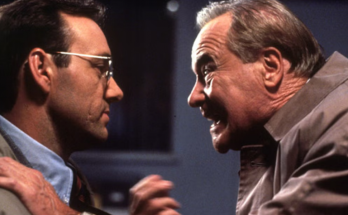
Richard Goodwin (Rob Morrow), an idealistic young lawyer working for a Congressional subcommittee in the late 1950s discovers that TV quiz shows are being fixed. His investigation focuses on 2 contestants on the show “Twenty-One”: Herbert Stempel (John Turturro), a brash working-class Jew from Queens, and Charles Van Doren (Ralph Fiennes), the patrician scion of one of America’s leading literary families. Based on a true story.
When Robert Redford passed last year, there were many obituaries & tributes that justly praised him for his acting, his activism, & ardent support for independent cinema, but it felt to me that his directorial career was mostly given short shrift. The fact is, Redford was a very accomplished filmmaker, & “Quiz Show” is his finest work. Everything in this film — from the cinematography to the editing to especially Paul Attanasio’s writing — is consistently inventive & superbly rendered. Best of all, it’s a fascinating slice of history wrapped in a brisk crackerjack entertainment that, aside for some streamlining here & there, for the most part hews close to the facts of the case.
Much of this film’s charm also grows out of Ralph Fiennes’ central turn as Charles Van Doren. Between 1993 & 1995, Fiennes seemingly appeared from out of nowhere (at least as far as filmgoers were concerned) & put in a trio of performances in which the characters were so different — in accent, in bearing, in temperament, etc — that I could hardly believe they were all being played by the same man. He made this between “Schindler’s List” & “Strange Days”, & I still marvel at the nuance he’s able to bring this very complex role. It also helps that he’s matched up with a stunningly talented cast who are all putting in some career-best performances, as well as a back bench of filmmakers utilized brilliantly in smaller roles (Martin Scorsese, Griffin Dunne, Barry Levinson).
In his 3-&-a-half-star review, Roger Ebert explained why this film set in 1957 had so much to tell us about our present: “The 1950s have been packaged as a time of Eisenhower & Elvis, Chevy Bel-Airs & blue jeans, crew cuts & drive-ins. “Quiz Show” remembers it was also a decade when intellectuals were respected, when a man could be famous because he was a poet & a teacher, when TV audiences actually watched shows on which experts answered questions about Shakespeare & Dickens, science & history. All of that is gone now . . . Now take stock of what we have lost in the four decades since “Twenty-One” came crashing down. We have lost a respect for intelligence; we reward people for whatever they happen to have learned, instead of feeling they might learn more. We have forgotten that the end does not justify the means — especially when the end is a high TV rating or any other kind of popular success. & we have lost a certain innocent idealism.”
At a time when people on the highest floors of American power openly lie without shame & brag about their self-dealing & corruption, this is a film that depicts an era in which the American people en masse were still capable of outrage at being lied to. That period of time to me now almost feels like science fiction.
https://www.youtube.com/watch?v=bj-m3Ddmn0E
Rosencrantz & Guildenstern Are Dead [1990 / Tom Stoppard / 117 min]
This film features a unique blend of humor and existential themes while exploring the lives of two minor characters from Shakespeare’s Hamlet as they navigate their scripted existence. Gary Oldman and Tim Roth provide performances praised for their depth and comedic timing, with clever dialogue and innovative storytelling. This is a thinker’s film full of intellectual humor and drama, and enjoyable to all audiences regardless of how familiar they are with the story of Hamlet.
https://youtu.be/u3xIs0aajN4?si=V2RDt-GhpxyeeoXl
Samsara [2011 / Ron Fricke / 102 min / Documentary / various countries]
“Samsara” takes the form of a nonverbal, guided meditation that will transform viewers in countries around the world, as they are swept along a journey of the soul. Through powerful images pristinely photographed in 70mm and a dynamic music score, the film illuminates the links between humanity and the rest of the nature, showing how our life cycle mirrors the rhythm of the planet.
https://www.youtube.com/watch?v=kcEj1m6YIDc
The Treasure Of The Sierra Madre [1948 / John Huston / 126 minutes]
This neo-Western film is set in 1925 Mexico. A couple of down on their luck Americans(played by Humphry Bogart and Tim Holt), meet an old prospector ( Walter Huston) They decide to go with him prospecting for gold up in the mountains. During this challenging endeavor they encounter many obstacles, including a harsh desert environment and bandits. In the end, it is greed and suspicion that are their most dangerous enemies.
“The Treasure of the Sierra Madre” won many awards. John Huston won Oscar for his direction and screenplay. His father Walter won an Oscar for acting. Humphrey Bogart gives one of his p=best performances. The film is beloved by critics and other filmmakers. It was selected for preservation by the Library of Congress for as an American masterpiece.